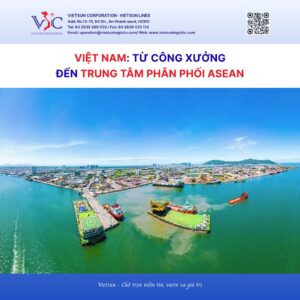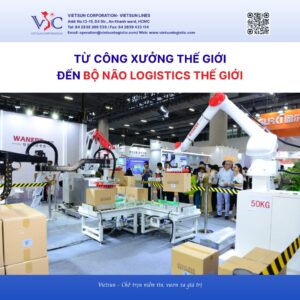
The LET-a CeMAT ASIA 2026 event in Guangzhou is highlighting a key trend in the global logistics industry: competitive value is no longer solely based on production capacity, but is shifting strongly towards the ability to coordinate supply chains using data and technology.
LOGISTICS MARKET
Lach Huyen New Port: A green piece to boost the logistics ecosystem at the northern gateway.
On May 27th, the Tan Cang Lach Huyen Logistics Center officially commenced operations in Cat Hai District, Hai Phong. This event not only adds a large-scale logistics center behind the Lach Huyen deep-water port complex but also contributes to completing the modern logistics ecosystem in the key economic region of Northern Vietnam.
Vietnamese and Guangzhou businesses: Expanding cooperation from infrastructure and logistics to high-quality human resources.
Economic relations between Vietnam and China are shifting towards a phase of deeper cooperation, focusing on strategic infrastructure, logistics, digital transformation, technology, and the development of high-quality human resources.
Peak season shipping: Does "hunting for sales" on freight rates really help businesses save money?
The global shipping market is entering its Peak Season 2026 as the Drewry World Container Index (WCI) rose 31 TP3T, reaching $2,286/FEU. The implementation of peak season surcharges (PSS), GRI, and EFS by major shipping lines has officially ended the short-term price reduction cycle.
Lien Chieu Port is shifting the central region's supply chain.
When a new deep-water port is under construction, the question often asked is: "How much FDI will this port attract?". However, the reality shows that port infrastructure has never been the sole factor driving economic growth or logistics capacity in a region.
Saigon Newport – Phuoc An Port: From a connecting point to a new logistics ecosystem in the South.
On May 13, 2026, the SNP – PAP Customer Conference, themed “Accompanying the Seas – Embracing New Opportunities,” held at Phuoc An Port, was not only an event connecting over 300 shipping lines, customers, and partners, but also clearly reflected the shifting trend of Vietnam's logistics industry: from individual competition to the development of an integrated logistics ecosystem.