On expressways undergoing phased investment, sleeper buses and trucks over 3.5 tons will only be allowed to travel at a maximum speed of 80 km/h instead of the current 90 km/h.
According to information from the Vietnam Road Administration, this unit has just allowed the Road Management Zones to adjust the maximum speed limit for some sections of the North-South East Expressway during the 2017-2020 period.
Accordingly, the Vietnam Road Administration assigned Road Management Area II to conduct a pilot program (from 3 to 6 months) to adjust the maximum operating speed to suit each type of vehicle on the phased investment expressways with 4 lanes, intermittent emergency stopping lanes, which have been put into operation and are currently regulated with a maximum operating speed of 90 km/h.
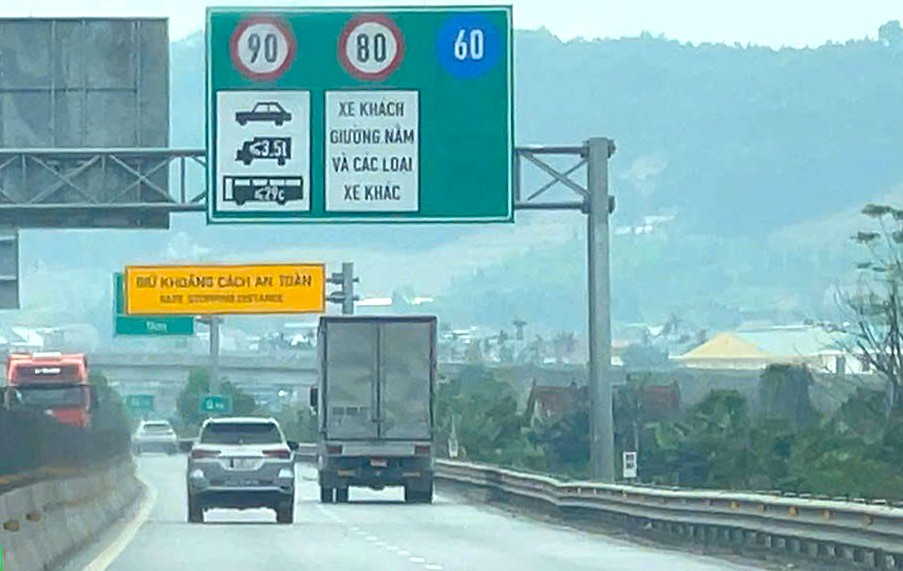
Simultaneously, review and reduce the maximum speed limit applied to all vehicles on expressway sections with limited technical characteristics (steep, prolonged longitudinal slopes, rutted or degraded road surfaces), and sections passing through areas frequently experiencing fog and limited visibility.
Specifically: For regular sections: Passenger cars, buses with ≤ 29 seats; trucks ≤ 3.5 tons will maintain the maximum permitted operating speed of 90km/h.
Sleeper buses and other vehicles are permitted to travel on the highway: the maximum permitted operating speed is 80 km/h.
The following expressways will be subject to a pilot speed adjustment program within the Road Management Area II: Nghi Son – Dien Chau, Dien Chau – Bai Vot, Bai Vot – Ham Nghi, Ham Nghi – Vung Ang, Vung Ang – Bung, Bung – Van Ninh, and Van Ninh – Cam Lo.
Similarly, within the Road Management Area I, the maximum speed limits for sleeper buses and trucks over 3.5 tons will be adjusted on the following expressways: Mai Son – National Highway 45, National Highway 45 – Nghi Son, and Nghi Son – Dien Chau.
According to the Vietnam Road Administration, over 3,345 km of expressways have been completed and put into operation nationwide. Many of these projects, implemented in phases according to the TCCS 42:2022/TCĐBVN standard, have achieved the required standards for flat curves, vertical curves, longitudinal slopes, and other indicators that meet the criteria for a complete expressway; the width is 4 lanes, and safety strips are appropriately arranged according to the phased scale; emergency stopping sections are not continuous on each direction.
The maximum operating speed of 90 km/h is currently applied to phased investment highways with 4 lanes and discontinuous emergency stopping lanes, in accordance with the regulations of TCCS 42:2022/TCĐBVN. This speed is consistent with the experience of many countries around the world. Highway lane widths in the US are 3.6 m, and in Japan 3.5 m, but they allow speeds up to 100 km/h, and in some cases even higher.
However, recently there have been a number of traffic accidents on some of the divided expressways, mainly involving trucks and buses, in which vehicles did not maintain a safe distance from each other, stopped or parked illegally, lacked warning signs, failed to control their speed, and committed other violations.
To enhance traffic safety, for routes currently operating with a maximum speed of 90 km/h, the maximum speed will be reduced to 80 km/h for passenger cars, buses with more than 29 seats (small passenger vehicles), double-decker sleeper buses, and trucks weighing 3.5 tons or more. A monitoring period of 3-6 months will be conducted to evaluate the effectiveness of this adjustment.
The Vietnam Road Administration has instructed highway management units to place traffic safety cones and parking signs at emergency stopping points and other necessary locations for drivers to use to warn other vehicles to pay attention and avoid emergency stops on the highway.
Implement additional reflective studs, reflective eyes, solar-powered yellow flashing lights, or other traffic warning lights powered by batteries, electricity, or solar energy to enhance visibility of emergency lanes in conditions with limited natural light.
Regarding traffic on highways during Tet (Lunar New Year), Traffic Police Team No. 4 (Traffic Police Department) also advises vehicle owners to strictly comply with regulations on speed and safe distance when traveling on highways.
During the Lunar New Year holiday, traffic volume on National Highway 1A is lower than on the expressway, so drivers should choose appropriate routes and paths to minimize congestion.